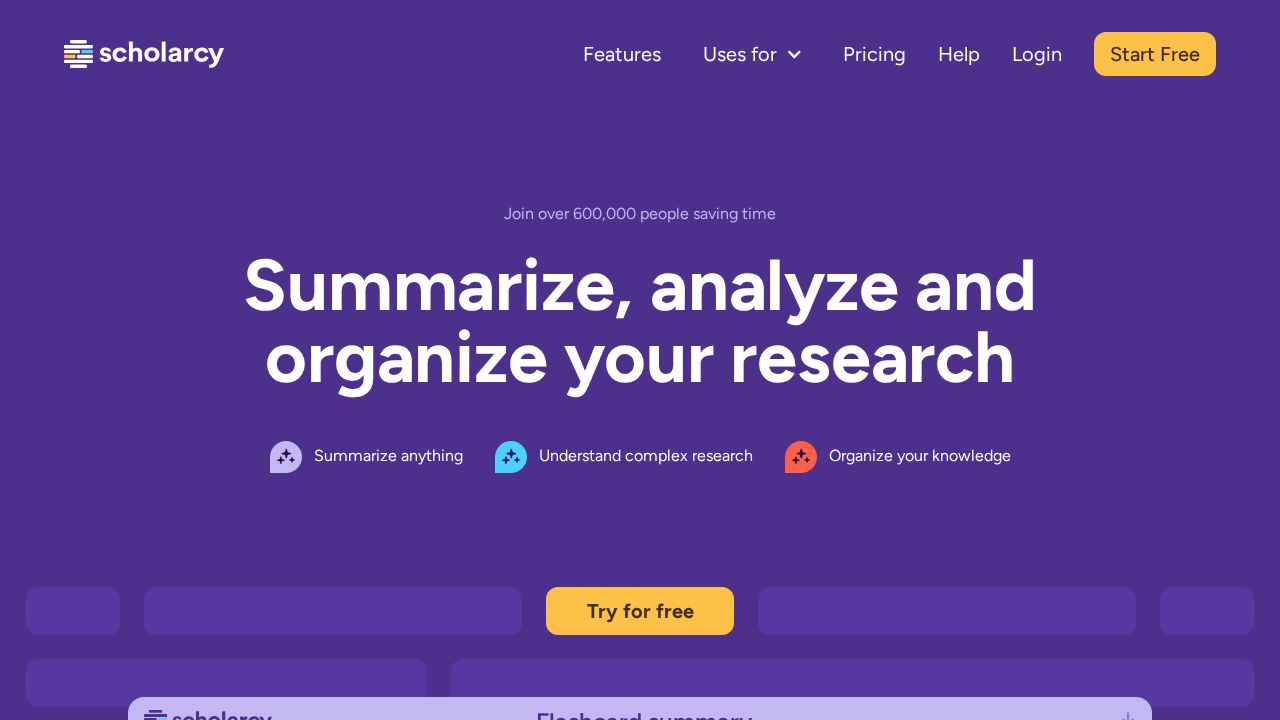
Scholarcy Review
Scholarcy automatically summarizes academic papers, reports, and articles into structured flashcards with key findings and references.
Verdict
Scholarcy occupies a focused niche in academic AI tooling, converting dense research documents into digestible summary flashcards that highlight hypotheses, methods, and key data—a genuine time-saver for literature reviews. It integrates with reference managers like Zotero and supports bulk processing of document libraries. The main limitation is that AI-generated summaries can miss nuance or misrepresent methodology, so critical verification against source material remains necessary.
Best for
Students and researchers looking to simplify their research workflow.
At a glance
Pros & cons
- Structured flashcard output tailored to academic documents
- Integrates with Zotero and reference managers
- Bulk document processing for large literature reviews
- Summaries can miss methodological nuance
- No mobile app
- Weaker on non-academic or informal documents
Related tools
Frequently asked
- Is Scholarcy free to use?
- Yes. Scholarcy has a free plan — Free plan available; Personal plan ~$9.99/mo; Library plan for institutions
- Does Scholarcy have memory?
- No persistent memory — sessions don't carry over by default.
- Can Scholarcy do voice or images?
- Voice: no. Image generation: no.
- What are the best alternatives to Scholarcy?
- Browse the AI Tools Directory for related tools.
Looking for an alternative?
MeMakie is an AI character chat platform with persistent memory, group chat, and a community feed of user-built characters. Free to start.
Try MeMakie → Browse more toolsFeatured on MeMakie
Listed here? Show it off and link back to your listing — add this badge to your site.

Notes from users
Concrete observations only — pricing changes, real-world feature behavior, what didn't work for you. Vague hot-takes get filtered out by automated review. No links allowed.
No comments yet. Be the first to add a real-world note about Scholarcy.