Rig Review
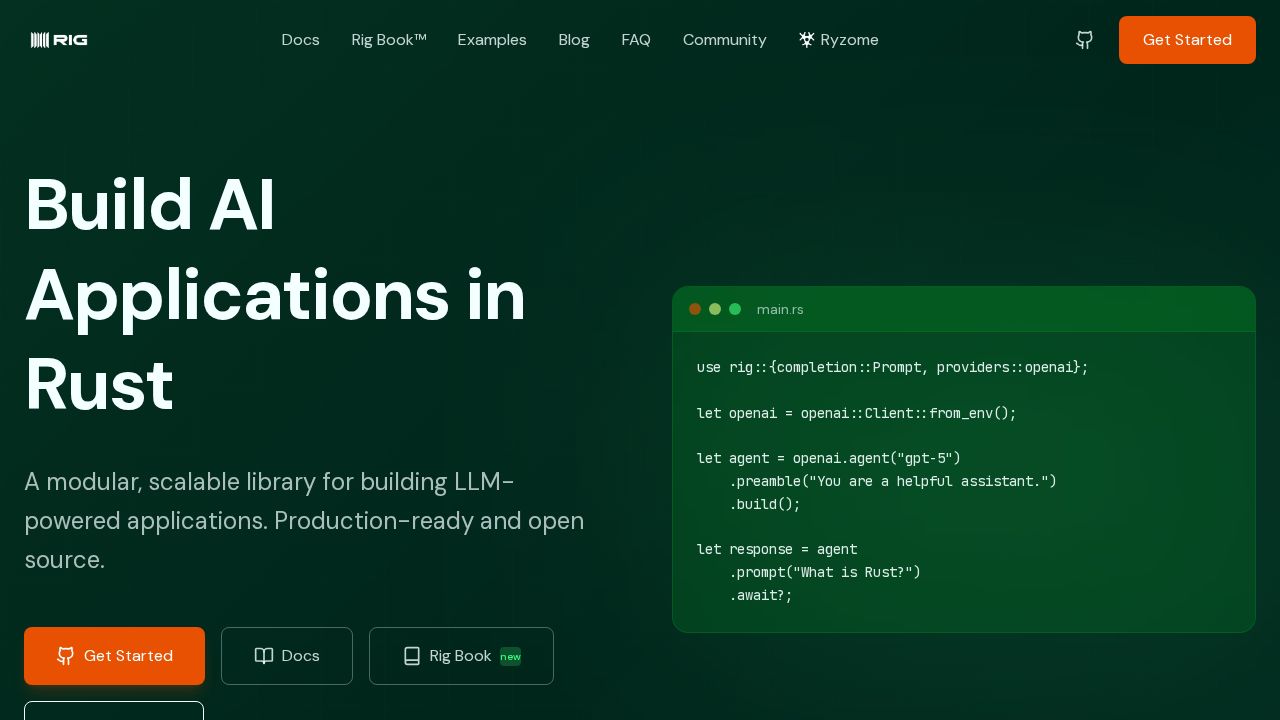
Rig is an open-source Rust library for building modular, high-performance LLM applications with a unified provider interface.
Verdict
Rig targets Rust developers who need production-grade LLM integrations without sacrificing memory safety or runtime performance. Its unified interface abstracts over multiple LLM providers, and its composable pipeline design suits complex agentic workflows. The obvious tradeoff is the Rust prerequisite — teams working in Python or JavaScript will find the ecosystem lock-in prohibitive despite the performance benefits.
What it does
Rig: Build modular and scalable LLM Applications in Rust. Unified LLM interface, Rust-powered performance, and advanced AI workflow abstractions for efficient development.
Best for
Rig is best for developers who want to build powerful LLM applications in Rust.
At a glance
Pros & cons
- Rust-powered performance and memory safety
- Unified multi-provider LLM interface
- Modular, composable pipeline design
- Requires Rust proficiency
- Smaller ecosystem than Python LLM frameworks
- Limited GUI or no-code access
Related tools
Frequently asked
- Is Rig free to use?
- Yes. Rig has a free plan — Open-source
- Does Rig have memory?
- No persistent memory — sessions don't carry over by default.
- Can Rig do voice or images?
- Voice: no. Image generation: no.
- What are the best alternatives to Rig?
- Browse the AI Tools Directory for related tools.
Looking for an alternative?
MeMakie is an AI character chat platform with persistent memory, group chat, and a community feed of user-built characters. Free to start.
Try MeMakie → Browse more toolsFeatured on MeMakie
Listed here? Show it off and link back to your listing — add this badge to your site.

Notes from users
Concrete observations only — pricing changes, real-world feature behavior, what didn't work for you. Vague hot-takes get filtered out by automated review. No links allowed.
No comments yet. Be the first to add a real-world note about Rig.