OTA Review
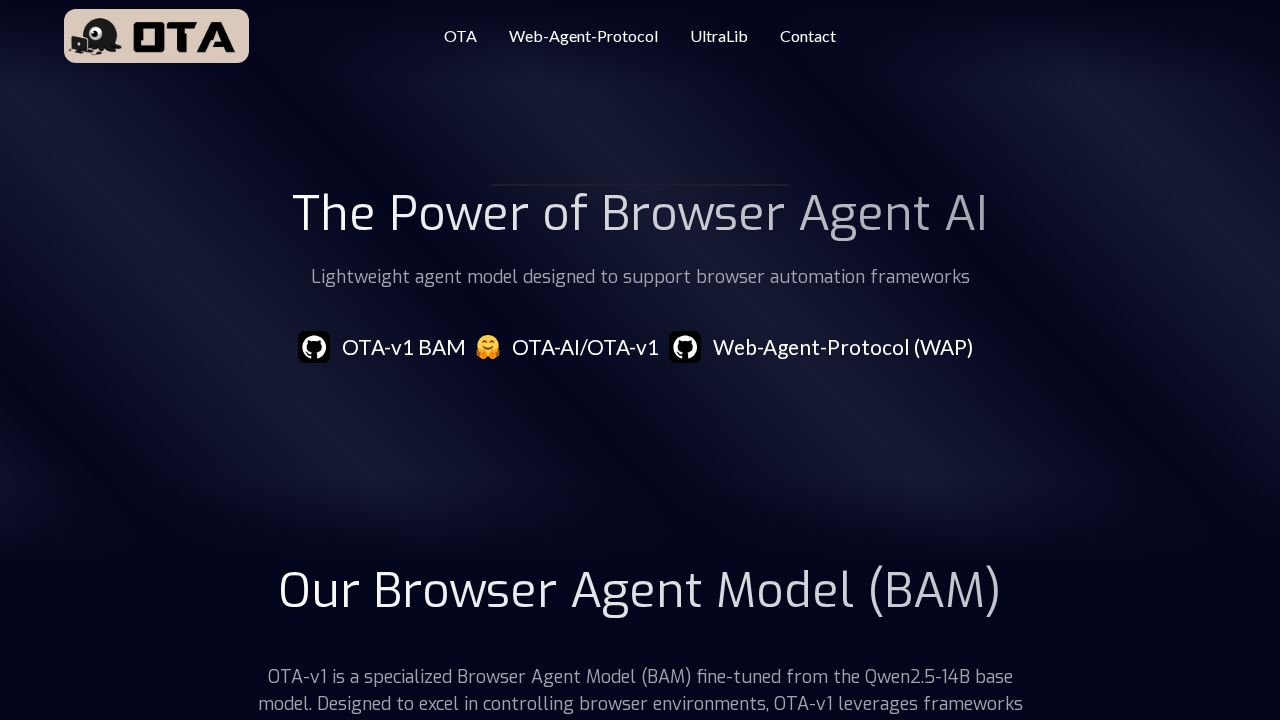
OTA-v1 is a browser agent model fine-tuned from Qwen2.5-14B, optimized for automated web tasks via frameworks like browser-use.
Verdict
OTA positions itself in the emerging browser-agent niche as a resource-efficient alternative to larger models: one DeepSeek V3 compute budget reportedly runs 65 OTA-v1 instances simultaneously, making it attractive for high-throughput web automation. Its 128k context window and inter-element attention are genuine differentiators for scraping, form-filling, and navigation tasks. The main tradeoff is limited ecosystem maturity — it depends on third-party frameworks like browser-use and lacks the broad community and tooling of foundation models.
Best for
OTA is best for developers and organizations seeking to automate browser-based tasks and interactions.
At a glance
Pros & cons
- Highly compute-efficient — 65x cheaper to host than DeepSeek V3
- 128k context with inter-element attention tuned for browser DOM
- Purpose-built for browser automation, not a general model repurposed
- Narrow use case outside web automation
- Pricing and access terms not transparent
- Ecosystem and community still nascent
Related tools
Frequently asked
- Is OTA free to use?
- Not entirely — Sign-up required; pricing not publicly listed.
- Does OTA have memory?
- No persistent memory — sessions don't carry over by default.
- Can OTA do voice or images?
- Voice: no. Image generation: no.
- What are the best alternatives to OTA?
- Browse the AI Tools Directory for related tools.
Looking for an alternative?
MeMakie is an AI character chat platform with persistent memory, group chat, and a community feed of user-built characters. Free to start.
Try MeMakie → Browse more toolsFeatured on MeMakie
Listed here? Show it off and link back to your listing — add this badge to your site.

Notes from users
Concrete observations only — pricing changes, real-world feature behavior, what didn't work for you. Vague hot-takes get filtered out by automated review. No links allowed.
No comments yet. Be the first to add a real-world note about OTA.