Deepnote Review
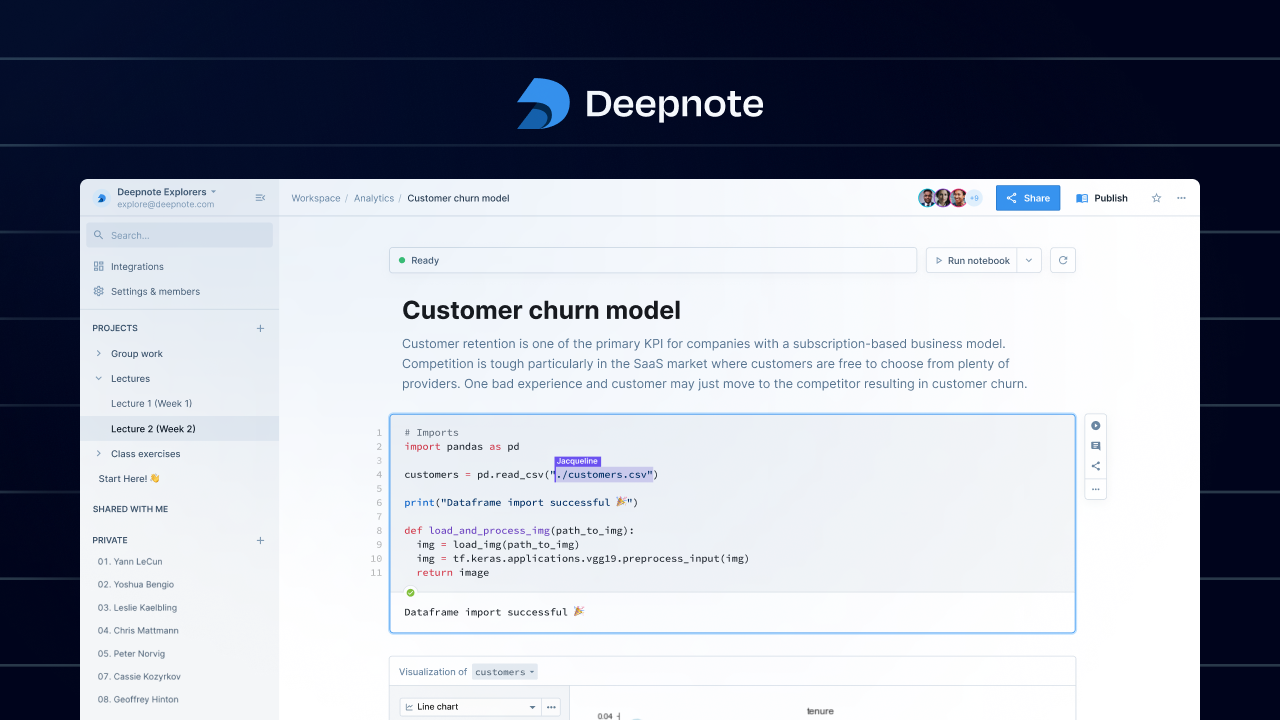
Deepnote is a collaborative data science notebook where teams explore data with Python and SQL, then share interactive insights.
Verdict
Deepnote competes directly with Jupyter and Databricks notebooks, carving out its niche through strong real-time collaboration and polished sharing features that make it especially appealing to analytics and data science teams. Its cloud-native approach eliminates local environment setup friction. The tradeoff is that solo data scientists or users with complex compute needs may find Databricks or a local Jupyter setup more flexible and cost-effective.
What it does
Explore data with Python & SQL, work together with your team, and share insights that lead to action — all in one place with Deepnote.
Best for
Data science teams and organizations looking for a collaborative analytics platform
At a glance
Pros & cons
- Real-time collaboration built in
- Supports both Python and SQL in one environment
- Cloud-native, no local setup required
- Less flexible for heavy custom compute environments
- Collaboration focus adds less value to solo users
- Feature depth vs. Databricks can be a concern at scale
Related tools
Frequently asked
- Is Deepnote free to use?
- Yes. Deepnote has a free plan — Free tier available; paid team plans
- Does Deepnote have memory?
- No persistent memory — sessions don't carry over by default.
- Can Deepnote do voice or images?
- Voice: no. Image generation: no.
- What are the best alternatives to Deepnote?
- Browse the AI Tools Directory for related tools.
Looking for an alternative?
MeMakie is an AI character chat platform with persistent memory, group chat, and a community feed of user-built characters. Free to start.
Try MeMakie → Browse more toolsNotes from users
Concrete observations only — pricing changes, real-world feature behavior, what didn't work for you. Vague hot-takes get filtered out by automated review. No links allowed.
No comments yet. Be the first to add a real-world note about Deepnote.