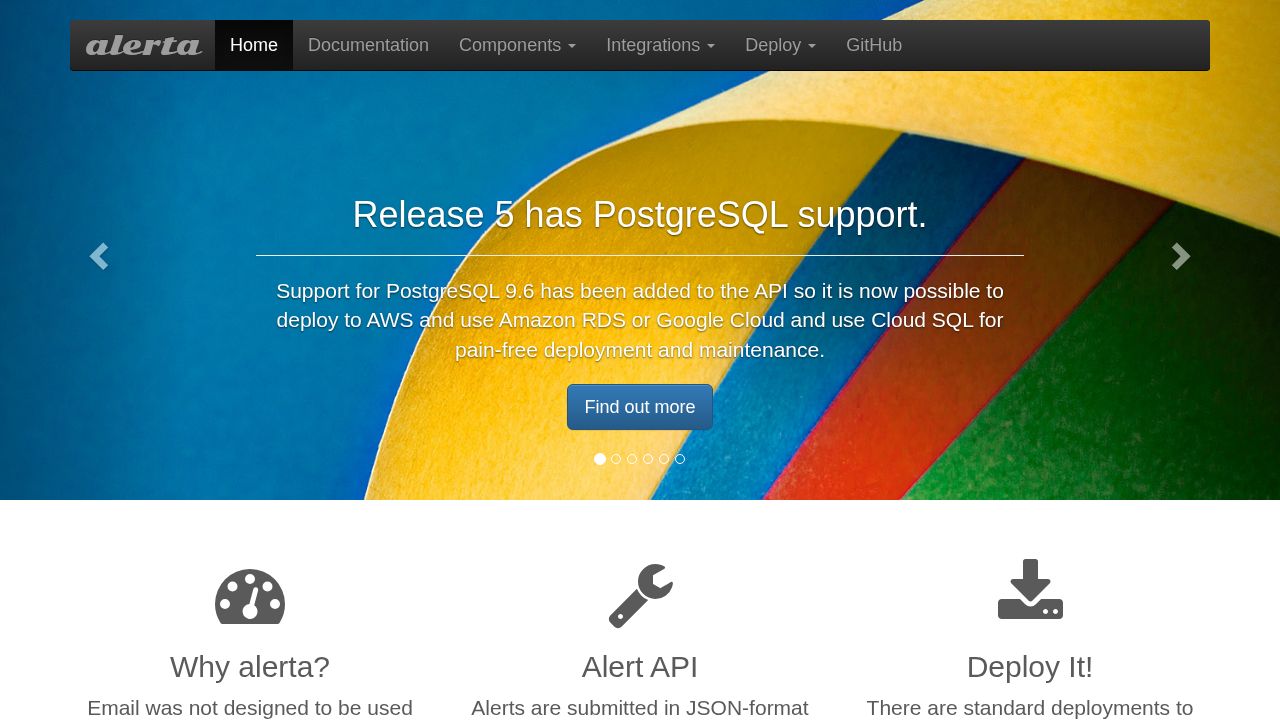
Alerta Review
Open-source alert management platform that consolidates, deduplicates, and correlates alerts from Prometheus, Grafana, Nagios, and 20+ monitoring integrations.
Verdict
Alerta is a mature, widely-deployed alert consolidation tool favored by DevOps teams needing a single pane of glass across heterogeneous monitoring stacks. Its standout strengths are flexible de-duplication, customer partitioning for multi-tenant environments, and a Docker image pulled over 2 million times. The tradeoff is that meaningful deployment still requires infrastructure know-how and self-hosting.
Best for
Organizations seeking a scalable and customizable alert management system for monitoring and alert visualization.
At a glance
Pros & cons
- 20+ monitoring integrations out of the box
- Multi-tenant customer partitioning
- OAuth, SAML2, and LDAP auth support
- Docker image with 2M+ pulls
- Requires self-hosting and infrastructure expertise
- Last major feature news appears dated
- No managed cloud tier
Related tools
Frequently asked
- Is Alerta free to use?
- Yes. Alerta has a free plan — Self-hosted, free; commercial support via third parties
- Does Alerta have memory?
- No persistent memory — sessions don't carry over by default.
- Can Alerta do voice or images?
- Voice: no. Image generation: no.
- What are the best alternatives to Alerta?
- Browse the AI Tools Directory for related tools.
Looking for an alternative?
MeMakie is an AI character chat platform with persistent memory, group chat, and a community feed of user-built characters. Free to start.
Try MeMakie → Browse more toolsNotes from users
Concrete observations only — pricing changes, real-world feature behavior, what didn't work for you. Vague hot-takes get filtered out by automated review. No links allowed.
No comments yet. Be the first to add a real-world note about Alerta.